Faith, displacement and survival beside Lake Izvorul Muntelui.
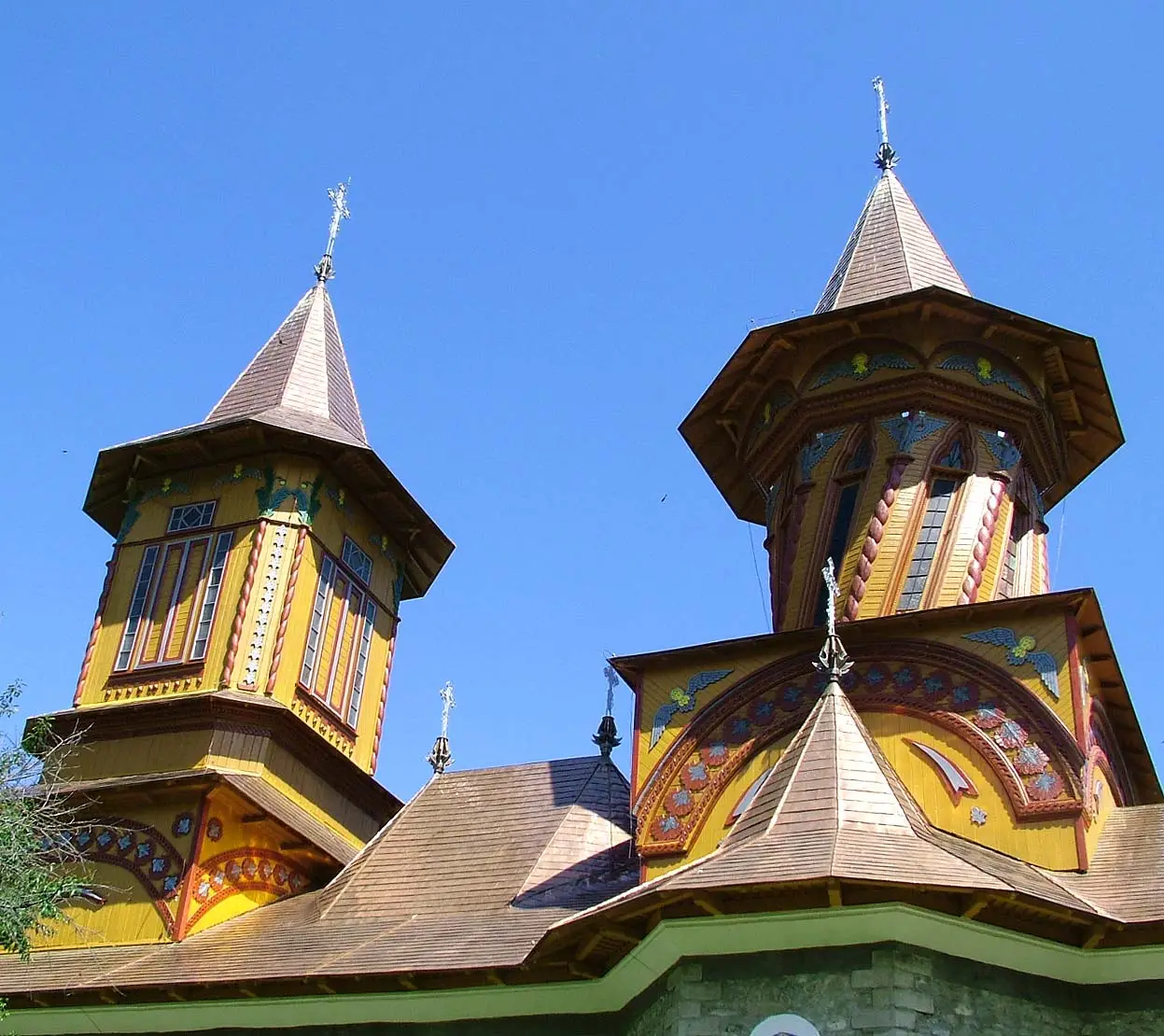
Painted twin towers with steep wooden-shingled roofs rise above a church in Ceahlău village. Photographed in 2007, the building shows the religious landscape of the mountain community as it survives beyond the creation of Lake Izvorul Muntelui.
Photograph: Ciobanu david, 2 August 2007 · CC BY-SA 3.0
Before the reservoir: Saint Anne and Durău
The churches of Ceahlău record a religious landscape much older than Lake Izvorul Muntelui. The wooden church dedicated to the Conception of Saint Anne stands in the parish cemetery. According to the Ceahlău parish, fifteen Transylvanian Orthodox families settled here and built it from fir logs in 1720, following confessional pressures across the Carpathians. That dating is part of the parish’s own history; a municipal heritage study and the national archaeological inventory describe the standing building as nineteenth-century, revealing the layers of tradition and building history surrounding the site.
At nearby Durău, Orthodox religious life grew around a monastic settlement traditionally linked with women religious. Its surviving brick church belongs to another architectural moment. Together, Saint Anne and Durău remind us that the area was inhabited, worshipped in and travelled through long before the reservoir was conceived.
Durău is also the place from which the evening toacă sounds across the valley in the opening scene of True Charm. For readers unfamiliar with Orthodox practice, the toacă is a wooden semantron: a seasoned board, often suspended under a small protective roof or in a monastery courtyard, sounded with wooden beaters. The player strikes measured and changing patterns, making the timber itself the instrument. In Romanian monastic life the call announces prayer and gathers the community; it is distinct from the deeper ringing of church bells that may follow. A sister assigned this ascultare, a monastic duty or obedience, may sound it, but the identity or seniority of the nun on duty at Durău on a particular evening is not independently documented. The novel gives that responsibility to one of the sisters.
The monastery’s own history recalls a women’s religious community associated by tradition with Marina, said to have taken monastic vows here in 1620. The present Annunciation church was built in the 1830s, with a cruciform brick plan, white exterior and iconostasis carved from gilded linden wood and painted in Constantinople in 1835. The monastery became a nuns’ community again in 1991. Its distinctive bell tower stands separately from the church, with a chapel on one level and the bells above. Monastery history; church architecture; bell tower.
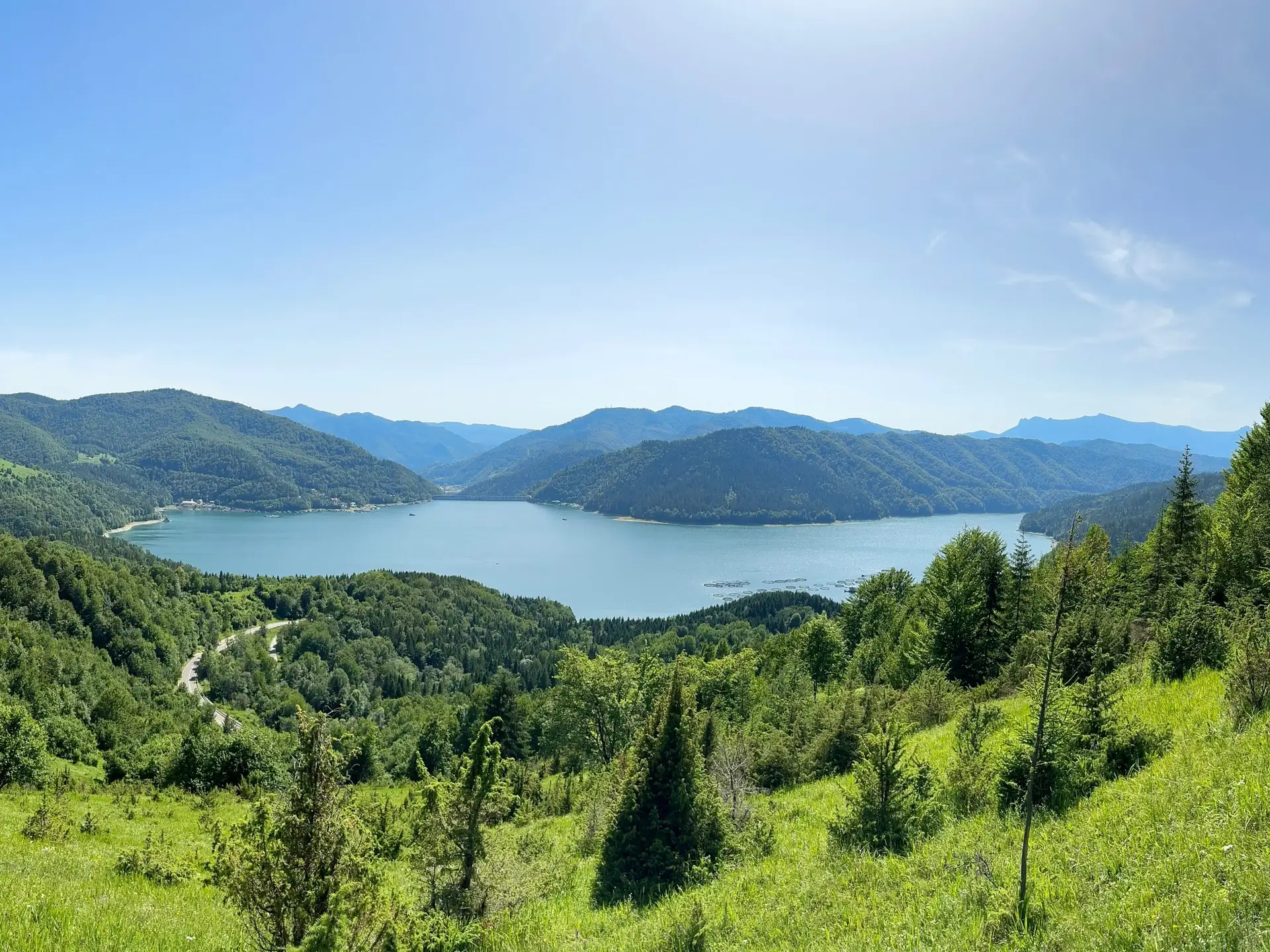
From a high mountainside in the Ceahlău region, the view opens towards Lake Izvorul Muntelui. The water now occupies a valley in which villages, churches and their congregations once formed a connected landscape; the surviving slopes provide a sense of the distances involved in relocation.
Photograph: Semcreate, 21 June 2024 · CC BY-SA 4.0
Răpciuni: a church moved from its village
The hydroelectric works at Bicaz displaced villages and remade the valley. The wooden Church of the Holy Archangels at Răpciuni, dated 1773, was dismantled in 1958 and reconstructed at the National Village Museum in Bucharest. It was saved as a building, but was separated from the village and the daily life in which it had stood. The distinction between survival and belonging gives the relocation its human significance.
Durău offers a different kind of continuity. Its church received an unusual twentieth-century cycle of paintings in wax, produced in 1935–37 by a team guided by Nicolae Tonitza, including Corneliu Baba; it was consecrated after the painting campaign in September 1937. Biblical scenes incorporate recognisable Moldovan landscapes and clothing.
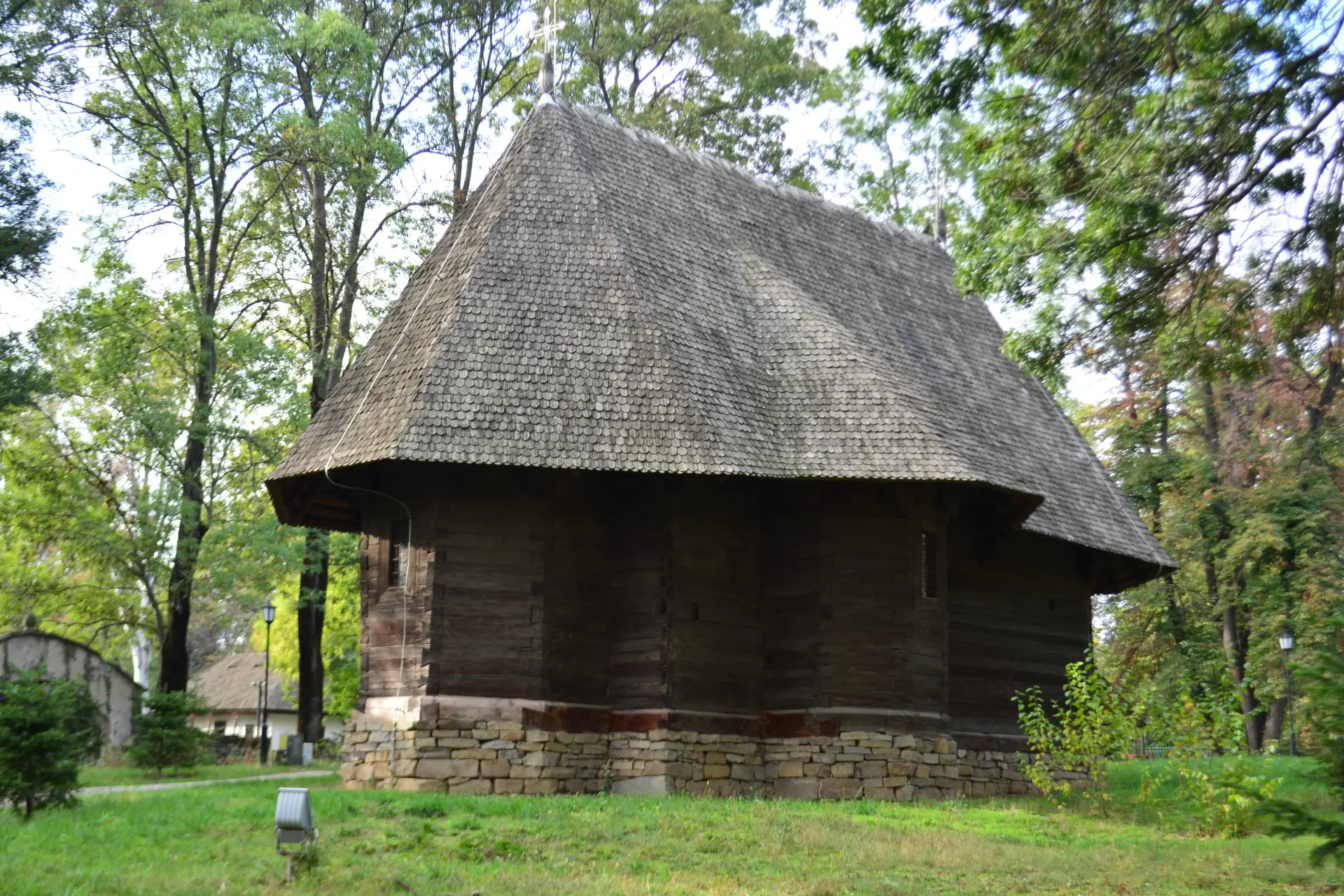
The wooden Church of the Holy Archangels, built at Răpciuni in 1773, stands today in Bucharest's Dimitrie Gusti National Village Museum. Dismantled in 1958 before the valley was inundated, it was reconstructed far from the people whose church it had been. The photograph records the preserved building in 2024.
Photograph: Joe Mabel, 9 October 2024 · CC BY-SA 4.0
The new parish church of Ceahlău, 1963
The Ceahlău parish church dedicated to the Nativity of the Mother of God was begun on 8 September 1929. Its structure is stone up to the level above the windows, but the vaults and two towers are timber, constructed by Nicolae (Nicu) Maxim of Dreptu. Building work was interrupted by war, then resumed from 1958 to 1963. Metropolitan Iustin Moisescu consecrated the church on 30 June 1963.
The parish is explicit that Saint Anne’s wooden church remained its principal parish church until this 1963 consecration. The transition was thus not the disappearance of Saint Anne but the transfer of regular parish worship to the completed church nearby. The two buildings remain part of one landscape.