




The arrival and the rooms of memory
✦In the saga
We shall begin where every proper introduction to the Victoria ought to begin: not inside the lobby, but on Calea Victoriei itself. Take a moment beside the corner with Strada Lipscani and look upwards. Honey-coloured stone rises above a busy Bucharest pavement; carved balconies and ironwork lead the eye towards the individual gilded letters spelling VICTORIA. Two marble lions hold their position at the entrance, unmoved by the succession of fashionable cars, hurried visitors and changing political seasons. This is a building that understands the pleasure of arriving somewhere.
From here the city is very much part of the hotel. The great CEC Palace makes its presence felt nearby, while the former Galeriile Lafayette, now Magazinul Victoriei, offers an Art Deco counterpoint to the Victoria’s older, more ornamented confidence. The pavement invites us to picture the lively street society that Ion Luca Caragiale captured in Grand Hôtel Victoria Română in 1890. In his sketch, the café and confectionery set tables and chairs so far outside that they reached the middle of the street, and by evening fashionable company had gathered to watch the world go by and to be watched in turn. Imagine the clatter of horses’ hooves and carriage wheels, the conversation over coffee, and the cheerful business of seeing who had arrived. Motorcars would make their appearance on Bucharest’s streets in the years to come; this was still predominantly the age of the horse-drawn carriage. Along Lipscani the frontage bends towards the beer hall, whose entrance promises another sort of hospitality entirely. But we shall leave its stained-glass windows and convivial tables for later. First, the front door.
Our car glides beneath the portico, where a member of the valet team is already approaching. Navy livery and gold braid belong to the Victoria’s established vocabulary of welcome, as do the polished brass luggage trolleys with their old V monogram. Kerem Șahın, the guest vehicle manager often seen on the day shift, knows the preferences of regular visitors; his younger cousin Emre covers the night hours. A greeting is delivered without fuss, luggage changes hands and, if the guest has entrusted a car to the hotel, it is taken off towards the garage behind the CEC Palace. The approach is more carefully organised than an ordinary kerbside stop: the Victoria has its own protected valet lane beside Calea Victoriei. Once a car has been handed over, the driver follows the short route by Mihai Vodă and Strada Ilfov to the multistorey garage behind the CEC Palace. He can be back at the hotel within moments, while the guest is still discovering the entrance. The operation is brisk, almost invisible. One has scarcely noticed it happening before someone is ready to open the brass-framed entrance doors.
The vestibule and the great reception hall
Just beyond those doors, the first object to reward an inquisitive eye is a commemorative brass plaque. It speaks of the Victoria’s long life as a hotel and cultural house and of the royal associations that remain important to its identity. A little farther on, the vestibule gives way to the reception hall, and the scale changes at once. A chandelier descends from a lofty coffered ceiling. White marble columns carry gilded capitals; pale stone catches the light; polished oak lends the whole space warmth rather than severity. The effect is richly theatrical but never cold. The city outside may be impatient; the Victoria has its own understanding of time.
At reception, staff know when a guest wants the full ceremony and when a quiet exchange of a room card will do. Simona is among the familiar faces at the desk. Emil, the concierge, wears a dark waistcoat trimmed in gold and combines an astonishing memory for guests with a talent for knowing exactly when not to intrude. He can arrange an introduction, tell an amusing story or simply nod and let you pass. For returning residents especially, that discretion is a considerable part of the welcome.
Should you prefer to pause rather than proceed straight to your room, Emil has a pleasant way of making the pause feel deliberate. In the velvet-screened alcove by Queen Elisabeta’s desks, a waitress may bring chilled sparkling rosé from Recaș, accompanied by fresh violets. It is precisely the sort of welcome Walt and Buzz receive in the manuscript: gracious, Romanian, and unhurried enough to make a first arrival feel like a return.
Now turn towards the pink-marble staircase curling up to the mezzanine. Above and beyond it, a pair of restored portraits looks out over the public hall: Ferdinand and Marie, young and splendid, before the weight of their later historical responsibilities had fully settled upon them. Their presence has a purpose beyond decoration. In the Victoria, royal faces return in different rooms and at different ages, lending the building the atmosphere of a family album that has somehow acquired public importance. Do not hurry past the portraits. We shall encounter the couple again in the American Bar, where their connection to the hotel takes a rather more sociable form.
Queen Elisabeta’s reading nook
A quieter corner awaits beside two dark-oak desks set beneath arched alcoves. A bronze plaque names it the Queen Elisabeta Reading Nook. Burgundy velvet screens a deeper seating area from the continual passage of the hall. Here you may sit with a book, wait for a friend or enjoy a glass brought over without unnecessary ceremony. The queen was also the writer Carmen Sylva, and the Victoria remembers the poetry salons associated with her name. A guest need know nothing of nineteenth-century Romanian letters to appreciate the gesture: the hotel has made a small, comfortable place for reading and conversation in honour of a sovereign who cared about both.
There are often small touches that settle the eye: a posy of violets near a curtain, a polished desk, a soft chair deliberately turned away from the busiest line of traffic. Beyond them, the lifts and corridors carry people towards less public parts of the building. We could follow the porters upstairs immediately, but it would be a pity to miss one of the Victoria’s most revealing rooms.
The little museum
From the grand foyer, take the left-hand turning before the American Bar. The museum occupies a quieter enclosure beside reception, its curved wall and former cigar-lounge rooms making it feel more intimate than its history might suggest. A model of the hotel gives you the building in miniature. Nearby are old room keys, photographs and remnants of the Lafayette years; one display records the earthquake of 4 March 1977, and a key from room 403 invites a particularly thoughtful pause. Other panels bring Queen Elisabeta’s poetry gatherings, Queen Marie’s balls and the tumultuous events of 1989 into the same long story.
The museum has its own human history. Emil has a special fondness for a portrait of Princess Elena, born into the Șuțu family and a friend of Queen Marie. Her husband, Prince Nicolae Ghica-Comănești, acquired the Victoria in 1912; she encouraged the hotel to give its collections a proper home. The museum you see now occupies repurposed rooms, but the impulse to preserve the building’s memory is much older. Other exhibits recall George Enescu’s connection with a piano downstairs, the underground nightclub of the interwar years and the hotel’s many transformations. A visitor could pass an absorbing hour here. We have a hotel still to explore.
Notice, as we turn back, that the museum also belongs to the Victoria’s practical circulation. A less conspicuous door leads away to a quiet passage and the service-lift route. The guest arriving through the main vestibule may never need it, but it helps explain how the hotel can be both grandly ceremonial and remarkably efficient behind the scenes.
The separate reading room
Before we rejoin the bustle of the bar, let me show you another, quieter room. It is quite distinct from Queen Elisabeta’s curtained reading nook beside reception. Smaller and more secluded, the reading room has deep leather armchairs, shelves of old books and a side table polished to a gentle sheen. A green-shaded lamp casts a mellow pool of light across the woodwork and upholstery. At one side is a modest bar stocked with brandy and port; beyond it, a discreet inner door connects with the hotel’s private service-side office. There is nothing ostentatious about this space. Its appeal lies in the proportions, the restful furnishings and the comfortable sense of being a little apart from the comings and goings of the Victoria.
The social life of the Victoria
✦In the saga
The Victoria is a hotel of several social temperaments. One can sit in contemplation beneath a royal portrait, make a solemn appointment over dinner or find oneself laughing quite helplessly with strangers over a tankard of beer. The extraordinary thing is that these moods live within the same walls without cancelling one another. For the next part of our walk, follow the sound of conversation rather than the signs to the bedrooms.
The American Bar and Bistro
Beyond a marble colonnade and a carved stone arch lies the American Bar and Bistro, one of the Victoria’s most polished meeting places. A small constellation of pendant chandeliers lends the room an intimate glow. The marble beneath our feet is milk-white with fine grey veins, softened here and there by carefully placed runners. Carved linden wood supplies the ornament; oak gives the structure its weight and age. The resulting proportions recall an elegant railway carriage, a Pullman salon transported into Bucharest and persuaded to put down roots. Somewhere in the background a melody by Gershwin or Cole Porter seems entirely at home.
The name is worth a little explanation. In the Victoria’s story, the American Bar opened in 1910 under the patronage of Ferdinand and Marie, then Crown Prince and Princess. What sounded American to European society was not a geographical promise but a new fashion in cocktails, conversation and cosmopolitan sociability, borrowed from the great hotel bars of London and Paris. The young couple appear once more in portraits at the far end of the seating area, gazing across a room that has kept something of their era without becoming its captive. Above the table, a painted royal face; beneath it, a very contemporary discussion. Few interiors manage that juxtaposition so gracefully.
At certain hours the person who explains this best is Loredana, an attentive waitress with auburn hair neatly gathered and a black uniform finished with ivory cuffs. Her knowledge of the room, its royal patrons and even its timberwork is unusually deep. She can recommend the house’s Blueberry Nail, a distinctly Romanian interpretation of the classic Rusty Nail, made memorable by a measure of afinată, the country’s blueberry liqueur or brandy. More importantly, she understands that every visitor has a different reason to be here. Someone seeking a discreet business conversation receives privacy; someone full of questions about the portraits will find an unexpectedly good guide. The bar now serves lighter food and daytime guests as readily as the evening cocktail crowd.
There is proper food here as well as cocktails. One much-appreciated dish in the American Bar is ciorbă rădăuțeană, the comforting, gently sour chicken soup associated with Rădăuți in northern Romania. When Edgar orders it in the saga, Loredana brings an especially accomplished version: tender chicken breast, lovage, wild garlic finely cut into a chiffonade, silky sour cream and a brightness of acidity that lifts the richness. It is precisely the sort of unexpected culinary discovery a grand hotel should offer: local, substantial and served without pretension.
We shall not linger over the contents of other guests’ conversations. The Victoria has long depended upon a useful understanding: the best staff are often those who notice everything and repeat very little. For a hotel in which diplomats, artists, businessmen and families sometimes occupy neighbouring tables, discretion is every bit as essential as fine linen.
The beer hall on Lipscani
Now let us change the mood completely. Retrace our steps through the arcade and follow the brass sign to Berăria Vârful cu Dor. Its name, the Peak of Longing, comes from the Carpathian mountain that provides the room’s visual centrepiece. This is not merely a small bar attached to a grand hotel. It is a world of its own, with broad proportions, old timber overhead and tall arched stained-glass windows admitting the light from Strada Lipscani. The painted mountain rises against a restless Carpathian sky on the great wall mural, with Peleș Castle below. It is easy to understand why a visitor sometimes forgets the time on first entering.
Warm wood, yeast and beeswax mingle in the air. Along the serving side, brass taps fill weighty glasses with golden Romanian beer; across the room a waiter steers a newcomer towards a good booth with the practiced generosity of someone who knows the views from every seat. Raised alcoves run along the north wall, a step above the floor, looking towards the little stage. A string or folk trio may be setting up. Nearby stands a cherished baby grand piano, remembered in the hotel’s lore as a gift on loan from King Carol that never really found its way home. The plaque beneath it offers another reminder of the Victoria’s delight in mixing public history with intimate pleasures.
Here the formality of the grand foyer gives way to companionable noise. A guest who has spent the day among officials may discover the comfort of a sturdy glass; a shy traveller may be introduced to half the room by the end of the evening. The vaulted windows and woodwork remain impressive, but the laughter is what makes the place live. It is no surprise that visitors to the Victoria often measure their first night in Bucharest by the fortunes of an evening at Vârful cu Dor.
The central bar, restaurant and garden atrium
The return towards the principal dining spaces reveals yet another aspect of the building. The Victoria has a substantial central bar serving more than one neighbouring area, useful both to residents gathering before dinner and to the staff carrying orders between rooms. Watch how the service flows: a tray is collected, someone crosses towards a table, another member of staff appears with a fresh pot of coffee, and the whole operation proceeds without the room ever feeling like a busy kitchen. In a hotel of this size, the choreography matters as much as the furnishings.
The main restaurant offers the more measured pleasures of a proper meal, with the quiet rhythm of table service and the anticipation that builds as the evening fills. Beyond it, towards the rear garden atrium, lies the Postăvaru dining room. The name may have sounded unfamiliar when someone first mentioned it at the American Bar, but by the time we reach the airy atrium it feels entirely at home. Here light, planting and an inward-looking garden atmosphere soften the transition between the public hotel and its more secluded spaces. The busy front entrance on Calea Victoriei seems a long way away, though in truth we have not travelled far at all.
Since we have arrived at Postăvaru, do ask about the beef. On one memorable evening in the saga, Walt and Buzz compare two Romanian breeds with the enthusiasm of men who have just found a reason to postpone going upstairs: Sură de Stepă, the indigenous Grey Steppe cattle, and Bălțată Românească, the Romanian Spotted breed. Walt declares the first even tastier than Angus, while Buzz praises both. The second has a particularly interesting heritage: it was developed in Romania by crossing local Grey Steppe cattle with imported Simmental stock, originally from Switzerland, rather than France. The breed’s history is documented in the Oklahoma State University livestock-breed register. Edgar, less devoted to red meat, has fish with vegetables and tomato sauce. A hotel where three dinner companions can disagree cheerfully about such dishes is clearly doing something right.
This is the right place to appreciate what the visitor does not normally see. There are service passages, rear doors and routes for provisions, linen and luggage, all connected to the hotel’s separate staff lifts. Their purpose is not to create mystery but to permit the public rooms to remain graceful and unhurried. The porters who relieved you of your bags at the kerb have been working in this quieter system; so have the kitchen and housekeeping teams. A good hotel tour ought to acknowledge them. Without their invisible labour, the Victoria would be little more than handsome stone and a collection of expensive chairs.
Follow the leafy garden atrium a little farther towards the back of the hotel and you come upon the quieter exit used by guests who prefer not to return through the front reception. A revolving door makes the transition from the planted, light-filled interior to the rear approach particularly gentle. Daniel passes this way in the Victoria’s story: a few steps from cultivated greenery and restaurant conversation, and the hotel gives him back to a less ceremonial part of Bucharest. The front portico announces the building to the city; its rear threshold permits a departure almost unnoticed.
We have now seen its sociable face, from restrained cocktails to exuberant beer and a leisurely dinner. Before we climb to the rooftop, however, you should know what it feels like to be a resident rather than a visitor passing through. Let us return to the lifts.
Private floors, rooftop garden and breakfast
✦In the saga
Upstairs: guest lifts, corridors and suites
Back in the reception hall, the most conspicuous way upstairs is also the oldest-looking. The guest lifts are brass cages set behind gilded grilles, their polished metal and wood making a simple ascent feel like an occasion. They move at a dignified pace, opening with a modest mechanical click rather than a theatrical flourish. As we rise, the chandelier dwindles below us; marble, mosaic and the curve of the staircase become a pattern seen from above. Piano music from somewhere beyond the mezzanine finds its way into the shaft. The Victoria has no need to hurry us from one level to the next.
There is, of course, another system of lifts. The porters’ trolleys travel by the service route, which connects the less visible corridors, the staff entrances and the upper floors. Luggage can reach a room before its owner has finished admiring the lobby. There are occasions when a regular guest will choose to accompany a bellhop by that route rather than take the gilded lift. It is an uncommon request, but the Victoria is a hotel whose people are rather good at understanding uncommon requests.
The public corridors above have a different character from the polished stone below. Heavy rugs from Transylvania soften the sound of footsteps in selected stretches; older woodwork and deep fabrics make the passageways feel inhabited rather than merely functional. The rhythm is one of doors, lamps, discreet signs and occasional glimpses of light from the windows. Someone may be returning from dinner with a newspaper tucked under one arm; another guest is waiting for the lift with a flower arrangement. Nothing here asks to be admired too loudly. The detail is in the way everything fits together.
On the third floor, the Victoria’s named rooms and neighbouring suites begin to make the past feel personal. Allen Trenchard is assigned the Lady Elena room, while Walt and Buzz occupy adjoining suites nearby. The furnishings marry traditional woodwork and deep textiles to discreet modern controls. An embossed room card may look reassuringly old-fashioned, but the brass-faced reader expects the card to be inserted fully, held until the green light appears and then withdrawn. Emil has been known to demonstrate the operation with exquisite patience to a guest who finds the contraption more challenging than it ought to be.
At the uppermost level, the accommodation becomes more like a private residence than an ordinary bedroom. The most imposing address is the King Carol I Suite, sometimes called simply the Carol. Edgar van Horn III occupies it in the saga. The top floor is reached by a staff-key-controlled route; stained-glass skylights throw soft colour across the carpeted corridor, which leads to a small marble vestibule and double doors. Within are dark woods, pale silk upholstery, broad internal rooms, a formal dining room and a full kitchen. When Edgar entertains, guests arrive not so much at a hotel suite as at a discreet apartment whose owner happens to have a remarkable staff at his disposal.
There is another royal name here: The Elisabeta Suite, recalling Queen Elisabeta, is the top-floor home of Daniel Mavrocordat and Diana Cojocaru during their extended stay. It is gracious but less expansive than Edgar’s, without his formal dining room and full kitchen; tall windows look down towards Calea Victoriei and Strada Lipscani, while its quieter rooms offer a refuge from the busy city. The hotel also has a Boier suite on its executive level, noted among its distinguished incoming reservations. These names are worth remembering: King Carol I, The Elisabeta, Boier and Lady Elena are not interchangeable accommodations but distinct addresses within the Victoria, just as its guests are distinct personalities.
If our tour has seemed to circle back on itself, that is intentional. The museum’s service passage, the discreet route past reception, the guest lift and the upper-floor corridors are all parts of one living building. Staff move through it with almost instinctive confidence; visitors gradually learn to recognise the junctions. No hotel is properly understood by reading its floor plan alone. It takes a little movement, a few wrong turns and perhaps a friendly intervention from Emil.
The garden above Bucharest
For our final ascent, we leave the residential floors and go up towards the sky. The rooftop garden is one of the Victoria’s loveliest surprises. What began in the hotel’s older life as a precarious walkway close to the roofline acquired a substantial terrace and fountain in the later twentieth century. Its subsequent owners expanded and restored the garden, adding clear protective panels, sound railings and surfaces intended to remain safe underfoot. The result preserves the pleasure of height without making the guest feel exposed to it.
The terrace is broad enough for several moods at once. There are places to stroll to the parapet and more intimate seating groups among roses and planters of geraniums; the grey and pink granite tiles take on a fresh colour with every change of light. But the great pleasure here is the extraordinary compass of Bucharest laid out around us. Let us walk slowly around the rim rather than attempt to take it all in at once.
To the south, follow the line of Calea Victoriei towards the river. The former Postal Palace, now the National Museum of Romanian History, stands on the left; on the right rises the richly ornamented CEC Bank, the old House of Deposits, beneath its celebrated dome. After dark that dome glows above the street, an illuminated punctuation mark in a view crowded with nineteenth-century façades. What appears from below to be a sequence of busy intersections becomes, from here, a beautiful avenue of stone, light and roofs.
Turn north, towards Strada Lipscani, which runs beside the Victoria. Across the roofs and the street stands the old Galeriile Lafayette building, now Magazinul Victoriei. Its Art Deco lines make an almost conversational contrast with the Victoria’s Beaux-Arts ornament; below, the crowds turn into little moving figures among shopfronts, cafés and the entrances to the Old Town.
Facing west, the eye falls first upon the exuberant Rococo-inspired stonework and mansard roof of the General Inspectorate of the Romanian Police, just across the lane. Beyond lies the Holocaust Memorial, and farther out the Dâmbovița stretches away towards the western horizon, glittering at sunset as if the river were drawn in one long, bright line into the distance. Closer to the hotel its course changes towards the southeast, providing the rooftop with one of its most distinctive views. The police building’s ornate roof and the river’s evening light are particularly compelling when the sun is low.
Eastwards lies another Bucharest altogether: the dense, jumbled roofscape of the Old Town, its streets full of visitors, beer halls, restaurants, music and ongoing merriment. Here the city is not an architectural postcard but a living theatre. On summer evenings its conversations and occasional bursts of laughter seem to drift upwards between the roofs. Swing your gaze back to the Victoria’s quiet garden, and the contrast becomes part of the charm. Few terraces offer such a complete portrait of the city.
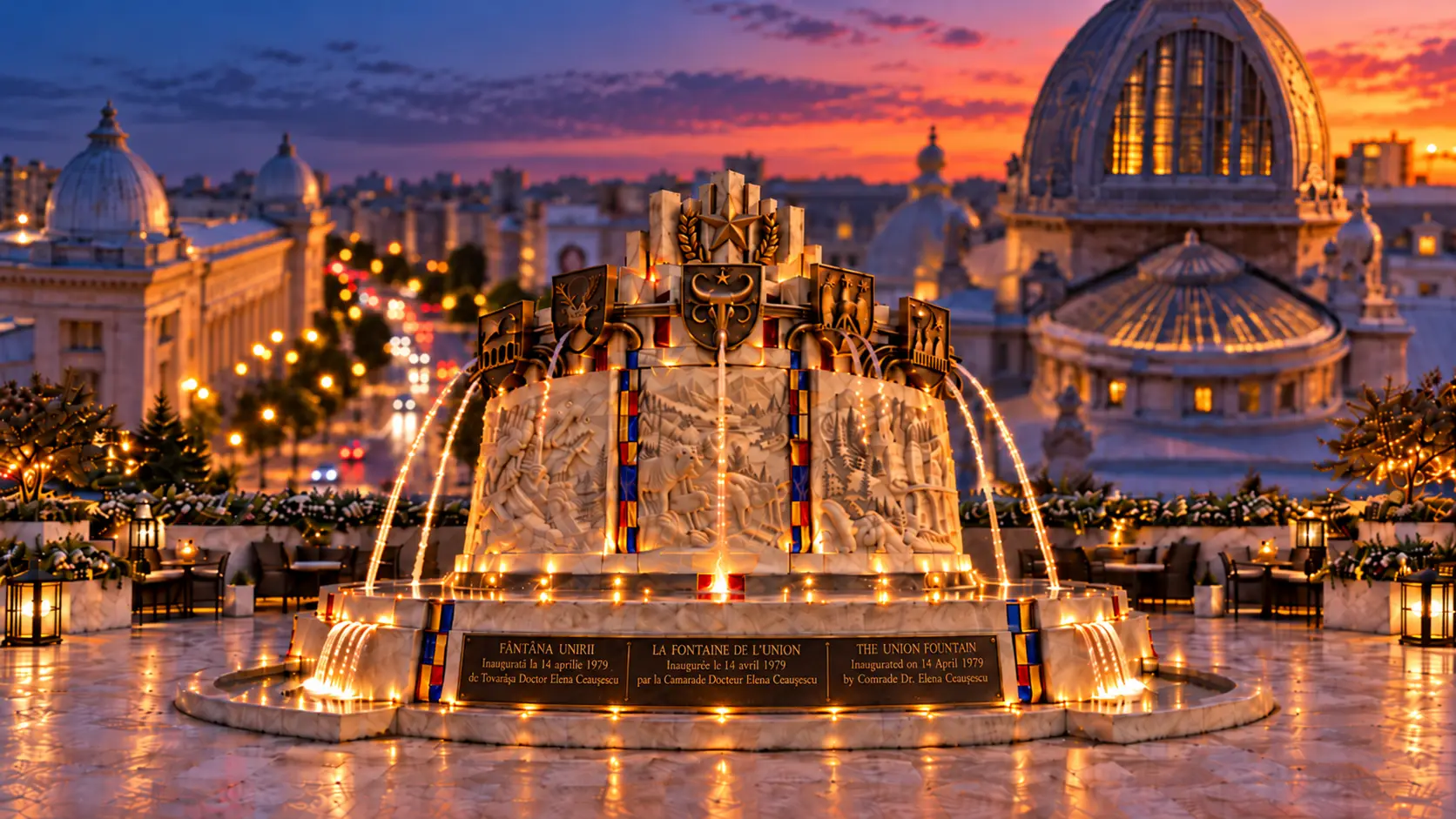
At the middle of the garden stands the fountain that gives the terrace much of its identity. It is called Fântâna Unirii, the Union Fountain. Its marble rises in a central, carved form, with bronze and brass details, coloured-glass inlays and heraldic shields projecting around it. The water does not burst into a noisy display. Instead, slender, carefully controlled arcs pass from the shields towards the basin, close enough to admire without interrupting a conversation. The arrangement was designed for people standing near it, not for an audience viewing it across a square.
A bronze inscription near the fountain recounts the remarkable history given to it in the Victoria’s world. It names the sculptor Zoe Băicoianu and dates the original commission to the 1970s, with the work eventually installed on the hotel roof after the earthquake. The reliefs draw on the country’s landscape and regions: mountains, rivers, churches, animals and signs of historic identities. A curious guest can trace the shields slowly around the marble and begin recognising Moldova, Dobrogea, Transylvania and the other provinces. Look closely and the emblematic creatures emerge from what first seemed merely decorative. Even the faint sound of the water becomes part of the lesson.
Beside the fountain is a sitting area with deep settees and armchairs, sheltered by flowers and the surrounding garden. This is the sort of place where a group begins by resting for five minutes and finds itself still talking an hour later. A visitor can watch the city without needing to claim the best view from the rail. There is room here for private thought, a close conversation and an unhurried party of friends. The fountain continues its soft work in the background, apparently indifferent to the day’s excitement.
Breakfast on the Union Terrace
We have reached the top of the building, but there is one more experience I would be reluctant to leave you without. Come back in the morning, when this same rooftop becomes the Union Terrace breakfast restaurant. The breakfast buffet is an essential part of the Victoria’s daily rhythm: it begins with the earliest guests and remains a tempting gathering place through the late morning, edging towards noon. You may wander between its offerings, then settle at your table for a properly cooked dish and another cup of coffee. After sunset’s gold and the stillness of night, the garden acquires a different purpose. Cups are laid out, fresh food is brought up and service moves almost silently between the seating groups. The city below is waking, yet up here there is time to consider the day before joining it.
It would be easy to order an entirely international breakfast, but the Victoria rewards a little local curiosity. Ask for the Romanian selection and the table may become a substantial celebration: fried eggs, good cured salami, smoked pork, telemea and cașcaval cheeses, warm franzelă bread, and mămăligă with sour cream and cheese. There may be liver pâté, cherry jam and pastries as well. Coffee arrives in porcelain so fine that it seems almost translucent in the morning light. The portions are generous; the atmosphere encourages taking your time. It is the kind of breakfast that can change a guest’s opinion of what a hotel morning ought to be.
The same staff who presided over the bar in the evening may be found bringing their courtesy and quiet competence to the terrace. Loredana, for example, is as capable of recommending a proper Romanian breakfast as of explaining the history of the American Bar. Meanwhile, the fountain catches the new light and the roses stir in the breeze. Nothing is staged for our benefit; these are simply the ordinary rituals through which a grand hotel becomes a familiar place.
Before we go, stand once more by the parapet and look back towards the city. Below us are the portico, the marble lions and the pavement where our visit began. Somewhere inside, Emil is greeting another arrival, Simona is handing over a room card, the beer hall is being made ready and the first conversations of the day are already beginning. The Victoria contains a museum, restaurants, salons and gracious suites; it also contains the accumulated habits of people who have made hospitality their craft. The finest thing about it may be that, having walked through all those worlds, you are no longer quite a stranger.