
Caragiale and the world at street level
Ion Luca Caragiale left a delightful glimpse of the establishment’s street life in Grand Hôtel Victoria Română (1890). His attention falls not on the pomp of the bedrooms but on the busy space below, where eating, conversation and the pleasure of watching Bucharest become inseparable.
A hotel woven into Bucharest
At the junction of Calea Victoriei and Strada Lipscani, the Victoria has been welcoming travellers since 1870. Its grand façade belongs to the broad-shouldered architecture of the capital’s confident years: honey-coloured stone, carved balconies, wrought ironwork and marble lions standing guard beside the portico. Above the entrance, individual gilded letters announce VICTORIA, while the hotel’s old monogram still appears on its brass luggage trolleys. The building has never needed to announce that it is important. The city has been doing that on its behalf for generations.
The address grew with Bucharest. Merchants, journalists, artists, foreign visitors and members of the royal court came to dine, meet, take rooms and be seen. Beneath the formal elegance lived something much more recognisably human: a café society, an excellent table, a familiar concierge and the chance of encountering someone whose company might alter the course of an evening.
A royal foundation and a living house
In the saga
The Victoria’s present stewardship continues its long association with Romania’s cultural and royal life. Fundația Colecția Familiei Regale a României, the Royal Family Collection Foundation of Romania, is the principal shareholder in the hotel’s operating company, Victoria pe Calea Victoriei S.A. The foundation’s work is conducted under the high patronage of Her Majesty Margareta, Custodian of the Romanian Crown, and Prince Radu, with Asociația Casa Majestății Sale as its institutional partner.
For its 150th anniversary in 2020, Bucharest gave the grand old dame of Calea Victoriei a day of pageantry: horse-drawn carriages rolled past her marble lions, a parade of figures in period costume filled the boulevard, and actors portraying King Carol I and Queen Elisabeta greeted the crowds as though the Belle Époque had returned for an afternoon.
Unveiled during those celebrations, the brass plaque in the entrance vestibule records the Victoria’s founding in 1870, its royal patronage and the responsibilities of its operator. Its closing words are the Royal Family motto, Nihil Sine Deo. It is the kind of inscription a guest can pause to read before crossing the reception hall, among the arrivals and departures of a working hotel.
From salons to the Royal Collection
The Victoria’s social life carried naturally into the new century. The American Bar became a fashionable meeting place in the years of Crown Prince Ferdinand and Princess Marie, its polished timber and intimate lighting offering a contrast to the brilliant public spaces beyond. Literary conversation had long been at home here. Queen Elisabeta, the writer Carmen Sylva, had appeared in the hotel’s smaller theatre for poetry readings, an association that later generations were determined not to let fade.
In 1912 Prince Nicolae Ghica-Comănești acquired the hotel. Princess Elena, connected to the Șuțu family and close to Queen Marie, pressed for the little theatre near the front of the building to become a museum. What began as an act of preservation became one of the Victoria’s great pleasures: a collection tracing the hotel’s own life alongside that of the city, curated in association with the Bucharest museum at Palatul Șuțu.
From the Grand Hotel Lafayette to the restored Victoria
The Victoria’s history begins in 1870, when the premises that would become the grand hotel were established on the busy commercial axis of Calea Victoriei. In the years remembered as the Grand Hotel Lafayette, the establishment belonged to a city discovering the pleasures of cafés, fine dining and rooms for visitors from abroad. Its changing names and successive alterations followed Bucharest through the monarchy, two world wars and the communist decades without erasing the character of the original address.
After the war, the hotel passed into state administration. Its salons and guest rooms continued to serve the capital, although practical alterations and years of restricted maintenance gradually obscured much of the earlier workmanship. The earthquake of 4 March 1977 damaged parts of the building, particularly towards the rear; repairs made the premises serviceable again, while the rooftop fountain and its marble setting gave the Victoria an unexpected new distinction near the end of the decade.
The Revolution of December 1989 brought new possibilities but no immediate rescue. Through the 1990s, uncertainty over ownership and the cost of preserving a large historic building delayed serious investment. By the early 2000s, a settlement of the property arrangements made a comprehensive rehabilitation possible. A Romanian-led investment company, supported by foreign capital, began assembling the financing and specialist architectural work necessary to save the fabric of the hotel as well as its business.
Detailed surveys and plans followed between 2004 and 2007. Structural consolidation and restoration began in stages from 2008, with the international financial crisis slowing the programme but not bringing it to an end. Original decorative features were conserved wherever practicable; damaged elements were reconstructed, and the rooms, lifts, services, museum and rooftop terrace were adapted to contemporary standards without losing their familiar appearance.
The principal works were substantially complete in 2014, and the Victoria reopened fully in 2015. The revived museum and exhibition rooms helped the hotel recover its place in Bucharest’s cultural life. During 2016 and 2017, the Royal Family Collection Foundation became increasingly involved in the institution’s future; the cultural relationship developed into the Victoria’s present royal stewardship. Formal high patronage followed in 2018, and in 2020 the Victoria’s 150th-anniversary celebrations included the unveiling of a brass plaque in the entrance vestibule, recording the hotel’s founding date, its cultural purpose and its association with the Royal Household.
The entrance, the reading nook and the museum
Pass between the marble lions and the scale of the place is immediately apparent. A chandelier descends from a high coffered ceiling above white marble columns with gilded capitals. Polished Moldovan oak warms the walls; a staircase of pink marble curls towards the mezzanine; and the original brass cage lifts travel behind intricate gilded grilles at a leisurely, reassuring pace. Portraits of Ferdinand and Marie look on from the reception hall. The effect is gracious rather than forbidding, grand enough to impress and comfortable enough to invite a visitor to linger.
Beside the reception desks, the Queen Elisabeta Reading Nook offers burgundy velvet, dark oak and a quieter rhythm. A little farther on, the hotel museum opens from the grand foyer before the American Bar. Old menus and room keys, photographs, decorative fragments, a model of the building and documents from the Victoria’s successive generations give the walls a memory of their own. A visitor who arrives only to check in may remain to explore an entire afternoon of Bucharest.
A terrace worthy of a capital
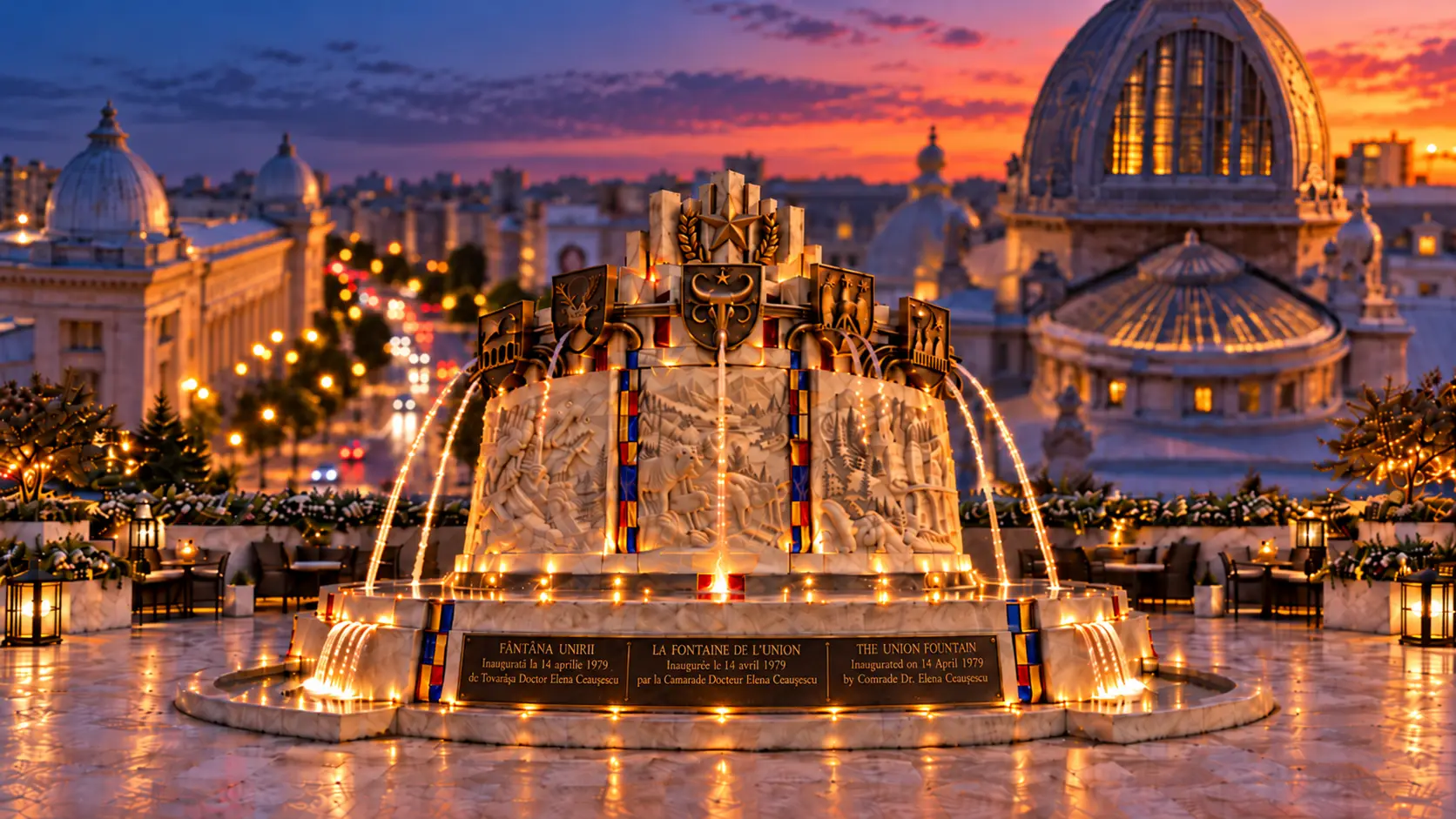
The hotel’s rooftop has changed as decisively as the rooms below. What began as a slender Belle Époque viewing walk developed into an elevated reception garden, a place where the city spreads out beneath the balustrades and evening light settles on the rooftops. Renovations during the Ceaușescu years gave the space its most remarkable centrepiece, the great marble and bronze Fântâna Unirii. Conceived for the Primăvara residence, the fountain was completed too late for President Ford’s visit and instead became the Victoria’s showpiece, unveiled during the visit of President Valéry Giscard d’Estaing in March 1979.
Its Rușchița marble, eight regional heraldic shields and astonishingly precise arcs of water offer a miniature journey across Romania. Later improvements to the terrace brought garden planting, discreet glass safety panels, comfortable seating and safer walking surfaces without surrendering the views. The fountain remains the focus of a setting where diplomats, hotel guests and friends can talk above the bustle of the streets.
Where the novel meets the city
Readers of True Charm encounter the Victoria in its everyday working life: attentive porters beneath the entrance canopy, Emil’s unruffled welcome at reception, a lift that seems to travel at its own aristocratic pace and conversations that move from the reading nook to the American Bar or upward into the garden. The hotel is both a splendid address and a place where people must navigate the ordinary complications of affection, work and discretion.
Outside, Calea Victoriei is always changing. Inside, the hotel remains unmistakably itself. By the time the sun reaches the fountain and the rooftops beyond, it becomes quite easy to understand why so many of the city’s stories have found their way through the Victoria’s doors.