Where folklore, faith, and everyday life remain closely entwined.
More Than the Word “Witch”
The women too often flattened into the English word “witch” occupy a far more complex place in Romanian tradition. They may be feared, respected, avoided, sought out, or quietly relied upon, depending on what has gone wrong and who still knows how to put it right.
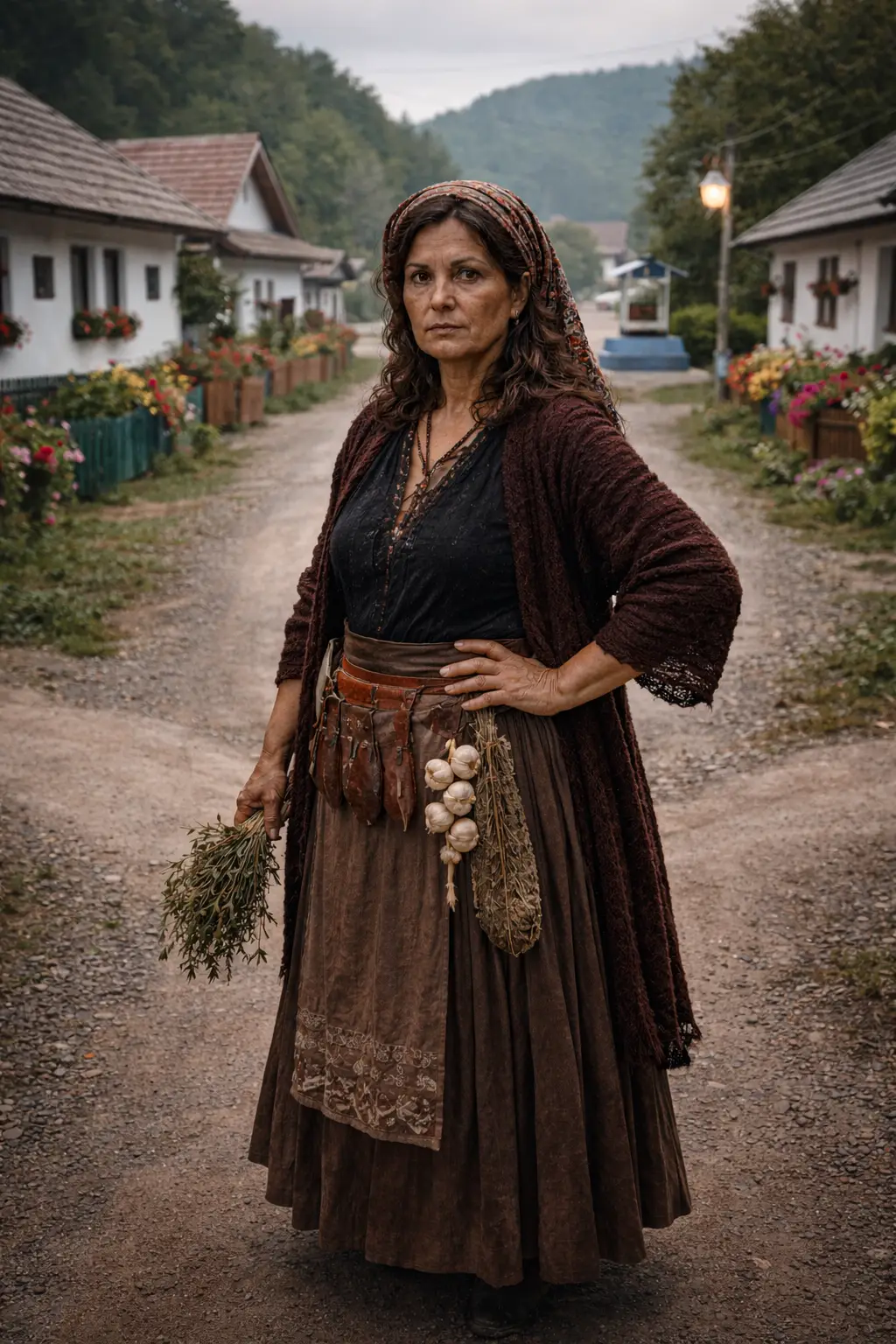
More often, they are understood as “descântătoare”, a Romanian term best interpreted in English as something like “incantresses”. These are women of spoken remedy, remembered formulae, household knowledge, and inherited authority. Alongside darker figures associated with harmful charms and curses, they also belong to a living culture of protection, cure, and quiet intervention.
Words, Objects, and Protective Signs
Their work is rarely a matter of spectacle. It lives instead in spoken charms, repeated gestures, and small protective acts by which a household tries to guard itself against harm.
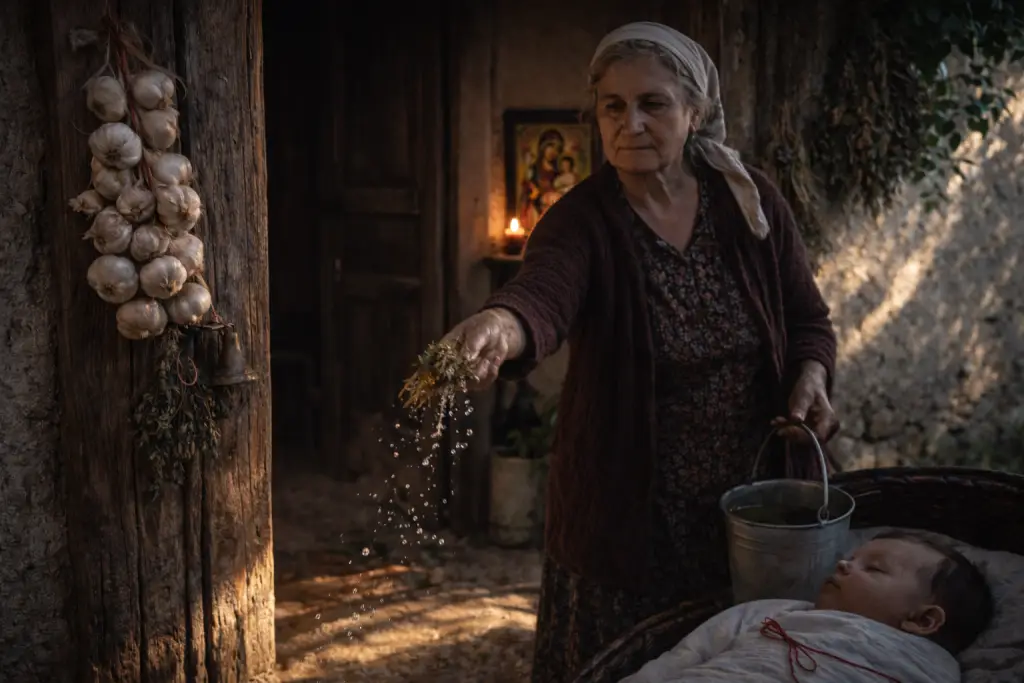
An incantress may work with “usturoi”, garlic plaited or bundled into protective forms and hung from belts, doorways, windows, cradles, or stable walls, or with “busuioc”, the basil carried in blessing, cleansing, and household rites. Salt, iron, water, ash, vinegar, thread, and marked thresholds belong to the same older world, where ordinary things gain force through timing, repetition, placement, and the right words.
Healing, Warding, and Undoing Harm
Some are remembered as healers. Others are feared as workers of harm. Many belong to the uneasy space between the two.
Their role is not only to comfort or protect, but also to cleanse, unbind, and undo. In Romanian belief, this often means treating “deochi”, the evil eye, lifting ill luck, quieting disturbance, or setting a troubled person or household right again. Cure and counter-charm are not always separate kinds of knowledge.
Authority, Reputation, and Quiet Trust
In Romanian life, such women are not always approached in a sensational spirit. They may be known instead as charmers, healers, protectors, midwives, herbal women, or keepers of old ritual knowledge.
Their authority rests less in display than in reputation, steadiness, memory, and the sense that they know what to do when ordinary measures have failed. A woman may be warned about in public, then quietly consulted in private when a child sickens, an animal fails, or a house no longer feels right.
Knowledge Shared Among Women
This knowledge is not always imagined as solitary. In some places, women’s ritual practice survives through shared memory, repeated phrases, spoken lines carried from one voice to another, and small acts carried out together.
Even where one woman holds the chief authority, the work itself can still belong to a wider female world of watching, listening, remembering, and quietly passing things on. Old cautions, old remedies, and the right way to speak a charm are often preserved not through books or institutions, but through memory, trust, repetition, and the steady reinforcement of other women who know the line.
Women at the Edge of Remedy and Fear
Romanian tradition preserves several overlapping terms for women who work with charms, remedies, and unseen influence. Some are remembered as workers of enchantment, especially in matters of love, jealousy, misfortune, or cursing. Others are known for healing rites, blessing acts, and the lifting of afflictions such as the evil eye, fright, wasting sickness, or bad luck.
This is never a neatly regulated world. A woman may be called for in secret because a child will not settle, a cow has stopped giving milk, a fever will not break, or a marriage has turned cold without obvious cause. The same figure may be spoken of respectfully by one household and warily by another. In village life, power and suspicion often travel together.
For that reason, the word incantress may be the more useful English term here. It suggests not fantasy spectacle, but a woman whose authority lies in spoken forms, inherited knowledge, ritual gesture, and old practical arts that sit at the boundary between cure and danger.
What an Incantress is Believed to Do
The Romanian incantress belongs to a world in which misfortune is rarely assumed to be merely random. Illness, barrenness, restless sleep, sudden quarrels, spoilt milk, frightened children, and wavering love can all be read as signs that something has shifted out of rightful order. In that setting, ritual knowledge has real social value.
Some women are sought for healing charms and protections. Others are feared for curses, love workings, envy, and harmful enchantments. The tradition itself draws a distinction between these two moral directions. Protective magic for a child, a flock, or a household can be seen as understandable, even praiseworthy. Harm done out of jealousy or revenge belongs to a darker category altogether.
That moral ambiguity is part of what keeps such women close to ordinary life. They are not creatures outside the village. They are part of the village’s own memory of danger, need, and remedy.
Healing Charms, Spoken Words, & the Evil Eye
One of the most persistent strands of Romanian folk practice is the descântec: a spoken charm or healing formula used against affliction. These are not usually presented as grand acts of sorcery. More often they resemble prayers, rhymes, whispered invocations, and repeated verbal patterns spoken over water, embers, herbs, or the body of the afflicted person.
Such charms are used especially against the evil eye, but also against fever, fright, snakebite, toothache, wasting weakness, and other troubles believed to have an unseen cause. A bowl of water with charcoals, a whispered formula, a crossing of the body, a herb blessed beforehand, or a cup from which the sufferer drinks can all form part of the remedy.
What matters here is not whether one chooses to read these acts as spiritual, symbolic, medicinal, or psychological. In Romanian village life, they are meaningful because they are known, remembered, and repeated. Their force comes from continuity as much as from belief.
Protective Magic in Daily Life
Romanian protective practice is rarely dramatic. It lives instead in the habits of thresholds, hearths, cradles, barns, and feast days. Garlic is hung by doors and windows, especially on dangerous nights. Holy water is sprinkled through rooms and yards. Icons watch over the house. Iron tools are placed at thresholds or beneath beds. Red thread is tied to infants or livestock. Bells, fire, ash, salt, basil, wormwood, and other plants all have their place in a wider language of defence.
These objects are not merely decorative. They form part of a practical grammar of care. To protect a baby, a house, a field, or an animal is not seen as theatrical excess, but as responsible household vigilance in a world where envy, spirits, curses, and bad influence are understood to travel through ordinary life.
This is one of the reasons Romanian protective magic remains so evocative. It is intimate. It belongs not to castles and laboratories, but to kitchens, porches, wells, fields, and the edges of sleep.
Faith, Tension, and the Orthodox World
Romanian Orthodoxy and folk practice do not exist in total separation. At times the Church condemns spells, superstition, and unsanctioned ritual. At the same time, village life often blends prayer, holy water, icons, saintly invocation, and older customary acts so closely that the boundary between official religion and household protection can remain blurred.
This tension is one of the defining features of Romanian tradition. A healer’s charm may invoke God, the Virgin, or the saints. A priest may bless a house believed to be under harmful influence. Holy water and folk remedies may be used side by side. In one register, the Church warns against superstition; in another, the rhythms of feast days, blessings, processions, and household sanctification help preserve the same enchanted view of daily life that makes such folk practices legible in the first place.
For that reason, the Romanian incantress does not belong to a world outside faith. She belongs to a world that faith and folklore both shape, even when they stand in tension.
Love, Harm, and Village Reputation
Not every incantress is remembered kindly. Folk memory also preserves women associated with love charms, curses, spite, and dangerous knowledge. Stories speak of knots tied to bind desire, objects buried to redirect fortune, pepper burned in a curse, or hidden bundles meant to sicken, weaken, or divide.
Yet even here, the social picture remains more complex than simple condemnation. Villages often tolerate such figures with caution unless harm is believed to have gone too far. Accusation, fear, and reputation can follow a woman for years, but execution and formal persecution are far rarer than in parts of Western Europe. In the Romanian and Moldovan world, suspicion more often leads to avoidance, counter-charms, church intervention, or quiet social pressure than to full-scale witch hunts.
This leaves a legacy in which the feared woman remains culturally visible. She is not erased from memory. She becomes part of the village’s own cautionary knowledge about envy, vulnerability, and the unseen costs of human malice.