

There is a moment during an eclipse when something utterly familiar ceases to behave as expected. The Moon, ordinarily so steady in the night, begins to darken. In a Romanian village, before the movements of the heavens were widely taught in schools, that sight could summon an explanation passed between generations: something had gone up into the sky and was eating the light.
That something was the vârcolac. Its name has the sound of the wolf about it, but its place in Romanian folklore is richer and stranger than the creature of modern werewolf films. This was a being imagined on a celestial scale, capable of disturbing the familiar order of the Sun and Moon. The stories varied, as living stories do, and people found their own ways of responding when the sky appeared to turn against them.
A night of changing lightO noapte a luminii schimbătoare
Follow the shadow across the Moon, then return to the light. An artistic illustration of the changing sky, not a photograph.
Urmărește umbra care trece peste Lună, apoi întoarcerea luminii. O ilustrație artistică a cerului schimbător.
The familiar MoonLuna familiară
When the Moon was bitten
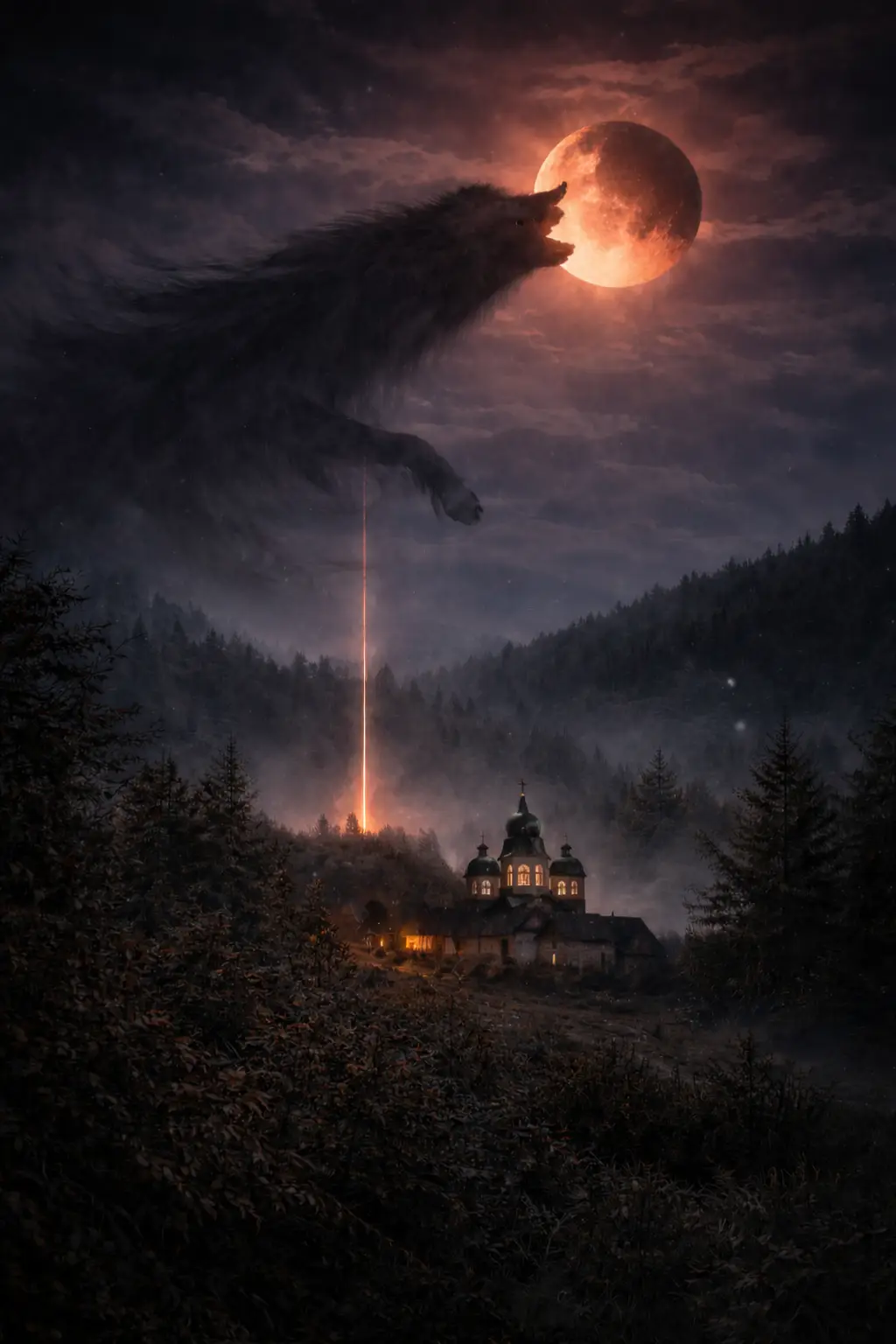
To watch a lunar eclipse is to see the Earth’s shadow travel across the Moon. In older accounts collected by folklorists, the sight could be understood very differently. A vârcolac had begun to devour the lunar disc, and the missing light marked the progress of its terrible meal. Solar eclipses sometimes received the same explanation. Here was a creature whose hunger reached beyond the earth.
Its appearance was far from settled. Some tellers imagined something wolfish or dog-like; others spoke of fantastic beasts, serpentine shapes or a presence closer to the world of spirits than to any animal. The instability of its form is part of the tale’s attraction. Every village could recognise the darkening Moon, yet the imagination might furnish a different devourer to explain it.
A wolf's name, a thread to the Moon
The word vârcolac has Slavic relatives associated with the wolf and the werewolf. Its Romanian meanings, however, do not always follow the same trail. In neighbouring traditions, kindred words evoke a creature that changes shape or returns from death. Romanian folk accounts very often place the vârcolac in the sky instead, occupied with the Sun or Moon.
That is worth remembering when an English translation offers only the word werewolf. The resemblance is real, but it can conceal what is distinctive about the Romanian stories. The vârcolac belongs to a night in which the heavens themselves are vulnerable, and the ordinary boundary between earthly life and celestial disorder no longer feels secure.
In certain collected accounts, even the sleeper was implicated. Villagers in Vâlcea spoke of a person whose soul went out during an unusually deep sleep and travelled towards the Moon. They feared that disturbing the body could prevent the wandering soul from finding its way home. One can see why this version was told softly: the sky’s danger might begin in an entirely ordinary house.
Other versions imagined a thread stretching between hearth and heavens. One account from the old Tecuciu district, around present-day Tecuci in southern Moldova, even linked the creatures to forbidden kinship, as though disorder in the heavens could spring from human wrongdoing. Spinning after dark, especially at forbidden hours and without candlelight, could leave a strand on which the vârcolac climbed. As long as it held, the creature kept its strength to attack the Sun or Moon; when it broke, that power failed and the creature withdrew into the air. Early collectors preserved this alongside quite different explanations, for Romanian folklore did not prescribe one settled account. Yet there is something unforgettable about the idea that a single strand spun beside the hearth might reach all the way to the Moon.
The story did not stop changing when the old collectors put down their pens. In Maramureș, Pamfil and Maria Bilțiu recorded people in the 1990s telling of a rather different vârcolac, a human being who took the shape of a dog or wolf-like creature. Their named storytellers described danger in hayfields and households, not a creature crossing the heavens. These accounts remind us that a shared name can shelter very different fears.
Nor did the celestial vârcolac disappear into the archives. During fieldwork in Oltenia between 2006 and 2010, ethnologist Natalia Golant recorded accounts of beings said to devour the Moon. It is an intriguing contrast: the country has preserved the wolf of the sky and the wolf that walks amongst people, and not always in the same villages or with the same meaning.
A village makes itself heard
People did not necessarily stand quietly watching the darkness advance. Accounts gathered in Romanian-speaking communities describe villagers raising a clamour, striking metal vessels and making noise to frighten away what they believed was attacking the heavenly body. The gesture is easy to picture: household objects suddenly enlisted in a struggle taking place far overhead.
These customs were not identical everywhere, nor did every family interpret the event in the same way. But they give the stories a wonderfully human quality. An eclipse was experienced by a whole community. Bells, voices, clattering pots and the apprehension of neighbours could turn an astronomical event into a shared night of action and remembrance.
What the shadow carried home
Even the Moon’s colour entered the telling. A reddish lunar disc might be imagined as a sign of the creature’s violence, while the restoration of light allowed fear to give way to relief. Such images offered a language for an event at once beautiful and alarming. They lived alongside prayers, seasonal observances and the ordinary labour of households, making the heavens part of village conversation.
Today the astronomy of an eclipse can be explained with admirable precision. That knowledge need not diminish the power of the old accounts. Their interest lies in what a community saw, feared, imagined and remembered. In the story of the sky wolves, the darkness was never merely an absence of light. It was a moment when people looked upwards together and asked what sort of world they inhabited.
In the saga
It is easy to see why the sky wolves belong naturally in the world of True Charm. The old accounts bring together an eclipsed Moon, a thread spun beside the hearth and the unsettling possibility that human conduct might disturb the heavens. The novels draw on that imaginative inheritance but give it their own moral and supernatural interpretation.
There is an important distinction. Recorded traditions do not agree about the fate of a wandering soul, and some are considerably darker than others when a connection is broken. The saga’s treatment of human responsibility and spiritual release is its own fiction. In Romanian Orthodox life, confession concerns repentance, forgiveness and reconciliation with God and the Church. The old village practices for facing an eclipse belong to another part of the country’s spiritual inheritance.
Sources and further reading
- DEX online, vârcolac, for meanings and older forms of the Romanian word.
- Tudor Pamfile, Cerul și podoabele lui (1915), for original accounts of spun threads, wandering souls and eclipse responses.
- Daciana Vlad, ‘Mărturii asupra vârcolacului în cultura tradițională’ (2017), for the creature’s varied folkloric forms.
- Elena Niculiță-Voronca, Datinile și credințele poporului român (1903), an early collection of folk beliefs and customs.
- Ion Otescu, Credințele țăranului român despre cer și stele (1907), a pioneering collection of Romanian accounts of the heavens.
- Pamfil and Maria Bilțiu, Izvorul fermecat (1999), named Maramureș informants and their stories of human-to-animal vârcolaci.
- Natalia Golant, ‘Reprezentări mitologice ale românilor din Oltenia’ (2013), modern fieldwork recording celestial Moon-devourers.
- Harry A. Senn, Were-wolf and Vampire in Romania (1982), comparative village fieldwork.
- Kamil Stachowski, ‘Etymologising the Slavic werewolf’ (2022), on the related and sometimes misleading regional names.
- Romanian Orthodox Church, ‘Taina Spovedaniei’, on confession, repentance and reconciliation.
These accounts describe beliefs and customs, not a scientific explanation of eclipses. Details vary by place, period and storyteller.